Home >> Events >> Seminars Archives
Seminars Archives
December 2025
11 December
3:00 pm - 4:00 pm
03 December
11:30 am - 12:30 pm
GO BEYOND BUILDING VIRTUAL CELL WITH ARTIFICIAL INTELLIGENCE
Location
L1, 1/F, Science Centre (SC L1), CUHK
Category
Seminar Series 2025/2026
02 December
11:15 am - 12:15 pm
Architecture and System Co-Design for Scalable Large Language Model Inference
Location
Zoom
Category
Seminar Series 2025/2026
November 2025
24 November
11:30 am - 12:30 pm
Randomised testing and test case reduction for GPU compilers
Location
MMW LT2
Category
Seminar Series 2025/2026
20 November
4:30 pm - 5:30 pm
Causal Representation Learning
Location
ERB LT, 9/F, William M.W. Mong Engineering Building, CUHK
Category
Seminar Series 2025/2026
19 November
11:15 am - 12:15 pm
Towards Embodied reasoning and alignment of large language models
Location
Zoom
Category
Seminar Series 2025/2026
06 November
11:00 am - 12:00 pm
LLMs for Secure Hardware Design: Opportunities and Challenges
Location
Room 801, 8/F, Ho Sin-Hang Engineering Building, CUHK
Category
Seminar Series 2025/2026
October 2025
08 October
4:00 pm - 5:00 pm
ASSESSMENT OF THE TECHNICAL AND NON-TECHNICAL SKILLS OF THE SURGICAL TEAM
Location
SHB 1021B
Category
Seminar Series 2025/2026
06 October
10:45 am - 12:15 pm
SURGICAL DATA SCIENCE FOR WOMEN’S HEALTH
Location
Room 801, 8/F, Ho Sin-Hang Engineering Building, CUHK
Category
Seminar Series 2025/2026
September 2025
26 September
10:00 am - 11:15 am
PIONEERING AI FOR SCIENTIFIC DISCOVERY AND SOCIETAL IMPACT – ZHONGGUANCUN INNOVATIONS
Location
LSK LT4
Category
Seminar Series 2025/2026
19 September
11:30 am - 12:30 pm
Computer Vision for Endoscopic Image Analysis – From Diagnostics to Intraoperative Applications
Location
L1, 1/F, Science Centre (SC L1), CUHK
Category
Seminar Series 2025/2026
12 September
11:30 am - 12:30 pm
HYPER-SCALE AI INFRASTRUCTURE: EFFICIENCY, RELIABILITY, AND BEYOND
Location
ERB LT, 9/F, William M.W. Mong Engineering Building, CUHK
Category
Seminar Series 2025/2026
03 September
3:00 pm - 4:00 pm
Public-Key Quantum Fire and Key-Fire From Classical Oracles
Location
SHB 1021B
Category
Seminar Series 2025/2026
02 September
11:00 am - 12:00 pm
Side-Channel For AI Security: For or Friend
Location
ERB 706
Category
Seminar Series 2025/2026
August 2025
29 August
2:00 pm - 3:00 pm
Test Database Generation For Text-To-SQL Evaluation and Beyond
Location
SHB 1021B
Category
Seminar Series 2024/2025
12 August
3:00 pm - 4:00 pm
Recent Advances in Adaptively Secure Threshold Signatures
Location
SHB 1021B
Category
Seminar Series 2024/2025
11 August
9:30 am - 10:30 am
Are Uncloneable Proof and Advice States Strictly Necessary
Location
Room 402, 4/F, William M W Mong Engineering Building, CUHK
Category
Seminar Series 2024/2025
11 August
11:00 am - 12:00 pm
From Automation to Autonomy: Machine Learning For Next-Generation Robotics
Location
Room 801, 8/F, Ho Sin-Hang Engineering Building, CUHK
Category
Seminar Series 2024/2025
June 2025
20 June
2:00 pm - 3:00 pm
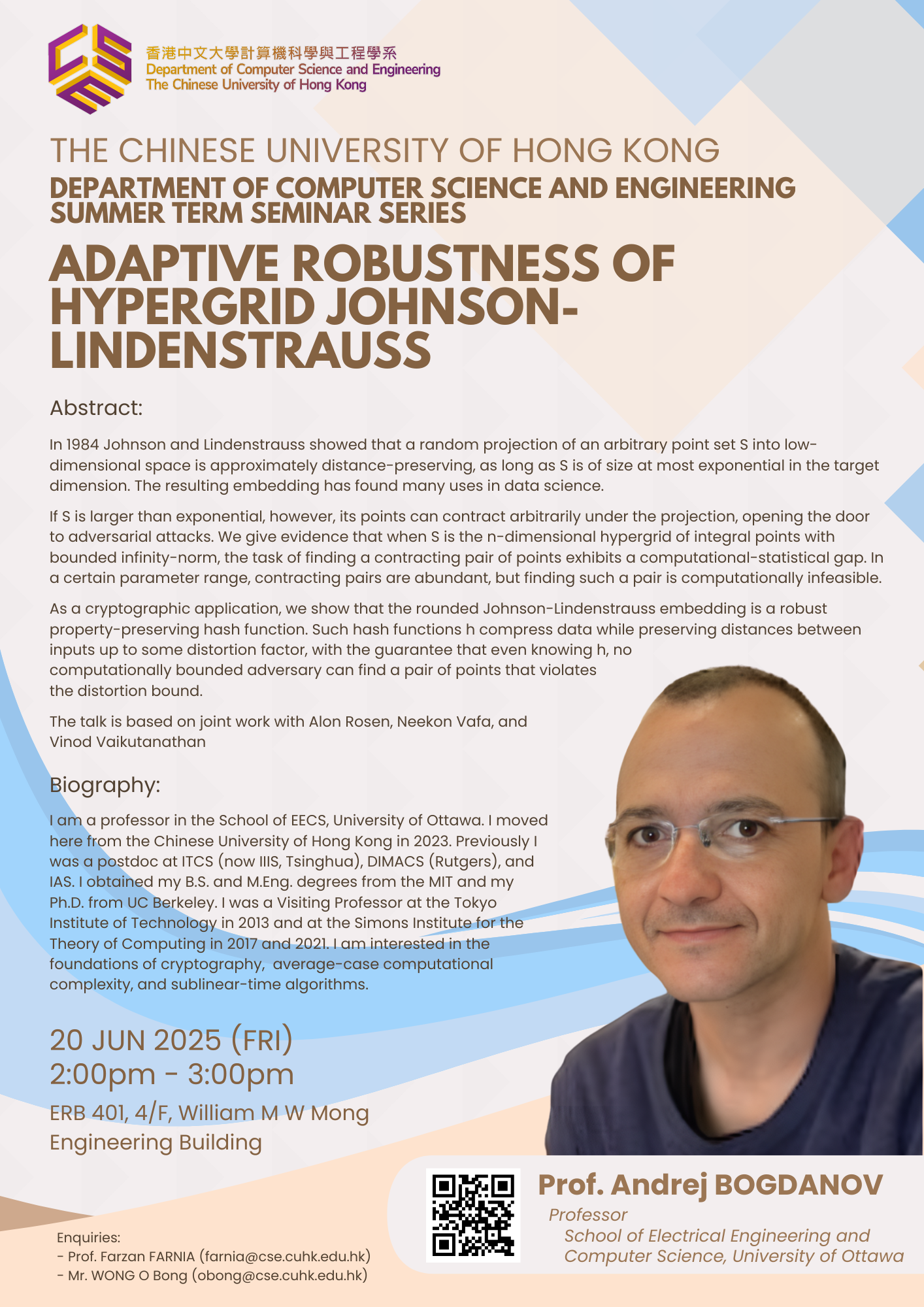
Adaptive Bobustness of Hypergrid Johnson-Lindenstrauss
Location
ERB401, William M W Mong Engineering Building (ERB)
Category
Seminar Series 2024/2025
19 June
11:00 am - 12:00 pm
Spatial Computing For Biomedical Innovation: Transforming HealthCare Delivery And Drug Discovery
Location
Room 804, 8/F, William M W Mong Engineering Building, CUHK
Category
Seminar Series 2024/2025
May 2025
14 May
2:00 pm - 3:00 pm
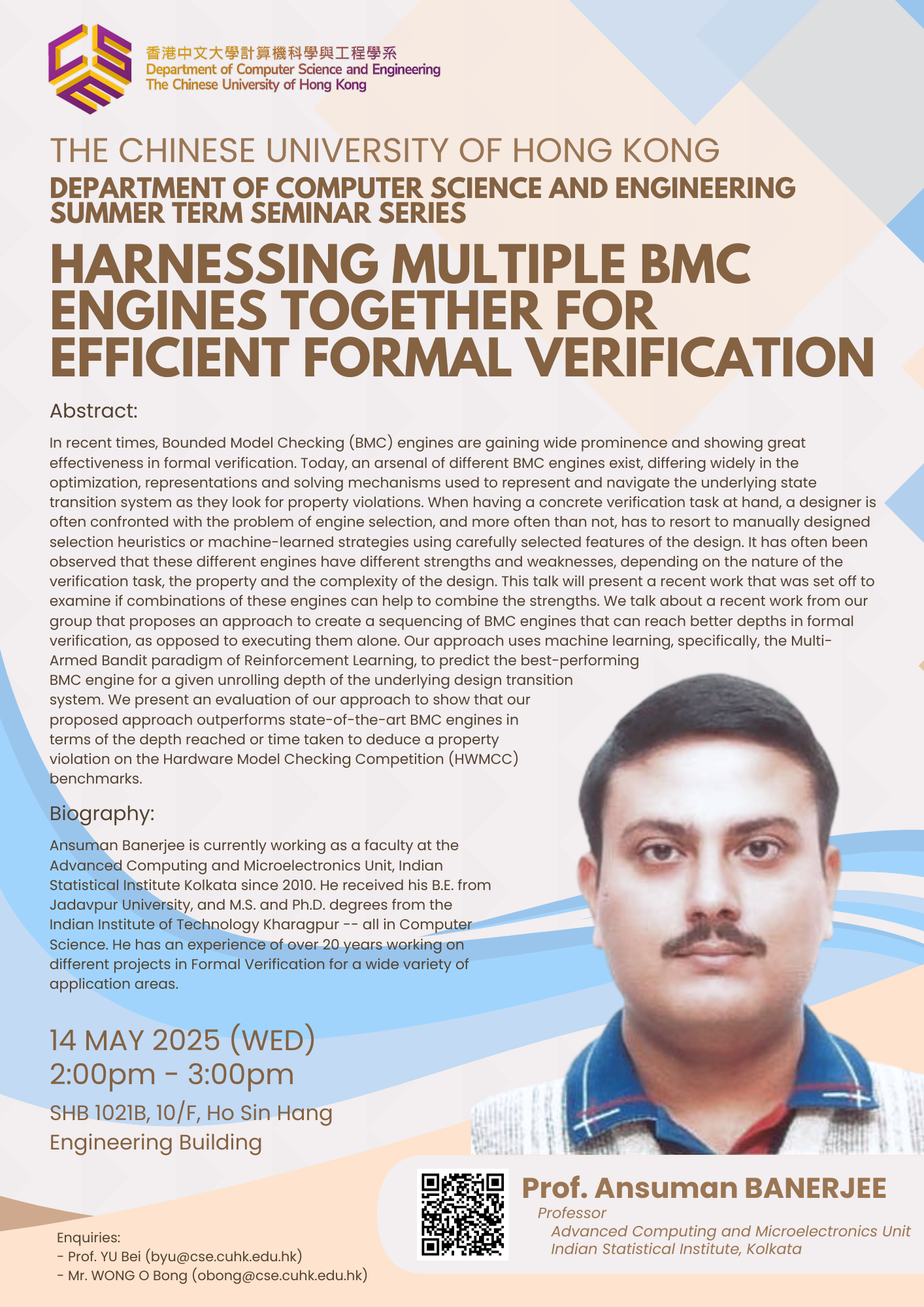
Harnessing Multiple BMC Engines Together For Efficient Formal Verification
Location
SHB 1021B
Category
Seminar Series 2024/2025
12 May
11:30 am - 12:30 pm
Model Merging with Sparsity: Theory, Algorithms And Applications
Location
Room 1027, 10/F, Ho Sin-hang Engineering Building, CUHK
Category
Seminar Series 2024/2025
April 2025
30 April
11:30 am - 12:30 pm
Towards A New Toolbox of Optimal Statistical Primitives
Location
ERB405, 4/F, William M W Mong Engineering Building (ERB)
Category
Seminar Series 2024/2025
29 April
10:00 am - 11:00 am
Smart Heart: AI-Powered Cardiac Shape Reconstruction, Motion Tracking And Data Generation
Location
ERB405, 4/F, William M W Mong Engineering Building (ERB)
Category
Seminar Series 2024/2025
28 April
3:00 pm - 4:00 pm
Tight Regret Bounds For Fixed-Price Bilateral Trade
Location
SHB 1021B
Category
Seminar Series 2024/2025
24 April
10:30 am - 11:30 am
From Recitation to Reasoning: Multimodal Large Language Models For Advanced Medical Intelligence
Location
L2, 1/F, Science Centre (SC L2), CUHK
Category
Seminar Series 2024/2025
16 April
4:30 pm - 5:30 pm
Unified Framework For Continuous-State Discrete Flow Matching
Location
ERB405, 4/F, William M W Mong Engineering Building (ERB)
Category
Seminar Series 2024/2025
11 April
9:30 am - 10:30 am
Human-AI Interaction: From Passive Observation To Interactive Interpretation And Steering
Location
T. Y. Wong Hall Lecture Theatre, Ho Sin-Hang Engineering Building, CUHK
Category
Seminar Series 2024/2025
11 April
2:00 pm - 3:00 pm
Designing Highly Accessible XR Interfaces
Location
L2, 1/F, Science Centre (SC L2), CUHK
Category
Seminar Series 2024/2025
09 April
10:00 am - 11:00 am
Hardware-Aware Algorithms and Holistic Systems for Ubiquitous Artificial Intelligence Across Edge and Cloud
Location
Zoom
Category
Seminar Series 2024/2025
08 April
3:00 pm - 4:00 pm
Learning to Reason With LLMS
Location
Room 402, 4/F, William M W Mong Engineering Building, CUHK
Category
Seminar Series 2024/2025
07 April
11:30 am - 12:30 pm
Modeling and Generating Interactions In 3D World
Location
Room 407, 4/F, William M W Mong Engineering Building, CUHK
Category
Seminar Series 2024/2025
02 April
10:00 am - 11:00 am
Enabling Ubiquitous 3D Intelligence Via Multi-Granular Algorithm-Hardware Synergy
Location
Zoom
Category
Seminar Series 2024/2025
01 April
2:00 pm - 3:00 pm
Generative AI and Empirical Software Engineering: A Paradigm Shift
Location
ERB LT, 9/F, William M.W. Mong Engineering Building, CUHK
Category
Seminar Series 2024/2025
March 2025
31 March
10:00 am - 11:00 am
Foundation Model For Scientific Discovery – With Applications In Chemistry, Material, And Biology
Location
Zoom
Category
Seminar Series 2024/2025
31 March
4:00 pm - 5:00 pm
Harnessing The Power Of Vision And Language To Improve Surgical Safety
Location
L2, 1/F, Science Centre (SC L2), CUHK
Category
Seminar Series 2024/2025
28 March
10:15 am - 11:15 am
Intelligent Physical Agents: High-Performance Learning For Generalist Robots
Location
T. Y. Wong Hall Lecture Theatre, Ho Sin-Hang Engineering Building, CUHK
Category
Seminar Series 2024/2025
26 March
10:00 am - 11:00 am
Advancing Security Red-Teaming Through Probabilistic Binary Analysis
Location
Zoom
Category
Seminar Series 2024/2025
24 March
3:30 pm - 4:30 pm
Verifiable Optimisation For Parametric Hardware Designs
Location
L2, 1/F, Science Centre (SC L2), CUHK
Category
Seminar Series 2024/2025
20 March
3:30 pm - 4:30 pm
AI For Medical Imaging, Digital Twins & Medicine
Location
MMW LT1
Category
Seminar Series 2024/2025
14 March
9:45 am - 10:45 am
Co-Design of Quantum Software And Hardware: From Digital To Analog
Location
Zoom
Category
Seminar Series 2024/2025
10 March
11:30 am - 12:30 pm
From Deep Reinforcement Learning To LLM-Based Agents: Perspectives On Current Research
Location
Room 407, 4/F, William M W Mong Engineering Building, CUHK
Category
Seminar Series 2024/2025
February 2025
28 February
11:30 am - 12:30 pm
Automated Prevention, Detection, And Repair of High-Impact Program Errors
Location
L2, 1/F, Science Centre (SC L2), CUHK
Category
Seminar Series 2024/2025
21 February
2:30 pm - 3:30 pm
Handling Ranges In Main Memory
Location
L1, 1/F, Science Centre (SC L1), CUHK
Category
Seminar Series 2024/2025
18 February
2:30 pm - 3:30 pm
Constructing Low-Depth Pseudorandom Functions From LPN
Location
Room 402, 4/F, William M W Mong Engineering Building, CUHK
Category
Seminar Series 2024/2025
January 2025
09 January
11:30 am - 12:30 pm
Learning Molecular Graphs under Label Scarcity and Distribution Shift
Location
L4, 2/F, Science Centre (SC L4), CUHK
Category
Seminar Series 2024/2025
December 2024
19 December
9:00 am - 10:00 am
Building High-Performance Digital Twins of Large Model Training Systems
Location
Zoom
Category
Seminar Series 2024/2025
17 December
2:30 pm - 3:30 pm
Unlocking the Value of Single Modality Through Multi-Modal Knowledge Transfer for Healthcare
Location
Room 801, 8/F, Ho Sin-Hang Engineering Building, CUHK
Category
Seminar Series 2024/2025
02 December
10:00 am - 11:00 am
Watermarking Generative AI Models
Location
Room 803, 8/F, William M W Mong Engineering Building, CUHK
Category
Seminar Series 2024/2025
November 2024
28 November
10:30 am - 11:30 am
Advances and Challenges of AI and Radiomics in Precision Radiotherapy
Location
Room 801, 8/F, Ho Sin-Hang Engineering Building, CUHK
Category
Seminar Series 2024/2025
27 November
2:30 pm - 3:30 pm
AI-Driven Fuzzing Across the Software Stack
Location
Room 801, 8/F, Ho Sin-Hang Engineering Building, CUHK
Category
Seminar Series 2024/2025
23 November
All Day
CUHK HomeComing Day 2024
Location
Ho Sin Hang Engineering Building (SHB)
Category
Seminar Series 2024/2025
22 November
10:00 am - 11:00 am
Enhancing Creative Control over GenAI for Design
Location
ERB LT, 9/F, William M.W. Mong Engineering Building, CUHK
Category
Seminar Series 2024/2025
22 November
2:00 pm - 3:00 pm
Digital System Design Automation
Location
L1, 1/F, Science Centre (SC L1), CUHK
Category
Seminar Series 2024/2025
22 November
4:00 pm - 5:00 pm
A Step For AI Copilot In Medical Diagnosis And Surgery
Location
L1, 1/F, Science Centre (SC L1), CUHK
Category
Seminar Series 2024/2025
21 November
10:30 am - 11:30 am
Instance-hiding interactive proofs
Location
Room 801, 8/F, Ho Sin-Hang Engineering Building, CUHK
Category
Seminar Series 2024/2025
21 November
2:00 pm - 3:00 pm
Towards Provable Unaligned Multimodal Learning: A Model Identification Perspective
Location
LSB_C1, G/F, Lady Shaw Building (LSB)
Category
Seminar Series 2024/2025
20 November
2:30 pm - 3:30 pm
Harness indirect certificates to design algorithms
Location
Room 801, 8/F, Ho Sin-Hang Engineering Building, CUHK
Category
Seminar Series 2024/2025
15 November
2:00 pm - 3:00 pm
How to Avoid Polarization in Recommender Systems with Dual Influence?
Location
L1, 1/F, Science Centre (SC L1), CUHK
Category
Seminar Series 2024/2025
October 2024
19 October
9:00 am - 6:00 pm
CUHK Info Day 2024
Location
Ho Sin Hang Engineering Building (SHB)
Category
Seminar Series 2024/2025
September 2024
20 September
3:00 pm - 4:00 pm
Machine Learning for Embodied Artificial Intelligence: from Surgical Robotics to Multi-robot Coordination
Location
L1, 1/F, Science Centre (SC L1), CUHK
Category
Seminar Series 2024/2025
09 September
10:00 am - 11:00 am
High-Performance Systems for Graph Analytics
Location
Lecture Theatre 1 (1/F), Lady Shaw Building (LSB)
Category
Seminar Series 2024/2025
06 September
11:00 am - 12:00 pm
Machine Learning in EDA: When and How
Location
L1, 1/F, Science Centre (SC L1), CUHK
Category
Seminar Series 2024/2025
06 September
2:00 pm - 3:00 pm
Exact and Optimal Dynamic Parameterized Subset Sampling on Bounded Precision Machines
Location
Room 803, 8/F, William M W Mong Engineering Building, CUHK
Category
Seminar Series 2024/2025
04 September
11:00 am - 12:00 pm
ARTIFICIAL INTELLIGENCE: PAST, PRESENT AND FUTURE
Location
Room 801, 8/F, Ho Sin-Hang Engineering Building, CUHK
Category
Seminar Series 2024/2025
August 2024
09 August
10:00 am - 11:00 am
MVSG-based Compact Models for GaN Devices
Location
Room 801, 8/F, Ho Sin-Hang Engineering Building, CUHK
Category
Seminar Series 2023/2024
Speaker:
Professor WEI Lan
Associate Professor
University of Waterloo
Abstract:
Given its high mobility, high breakdown voltage and decent thermal conductivity, GaN technologies have shown great promise for high-power high-frequency (HP-HF), rapidly rising as a front runner for mm-wave to THz analog/RF circuits for IoT and 5G/6G wireless communication. Meanwhile, it is also heavily explored for power electronic applications for fast charging, data center, and electric vehicles. As GaN technology continues to improve, challenges of high design cost and sub-optimal system performance emerge as bottlenecks preventing the technology from wide scale deployment. Accurate, scalable and efficient compact model is key to overcome such challenges.
This presentation will provide a brief overview of the family of MVSG GaN compact model, including models for GaN HEMT, GaN multi-channel diodes and GaN transmission-line resistors. The model formulation and various features will be introduced. Application examples will also be demonstrated, showing the potentials of this group of physics-based compact models.
Biography:
Prof. Lan Wei received her B.S. in Microelectronics from Peking University, China (2001), M.S and Ph. D. in Electrical Engineering from Stanford University, USA (2007 and 2010, respectively). She is currently an Associate Professor at the University of Waterloo, Canada. She has intensive experience in device physics-based compact modeling including silicon and GaN technologies, device-circuit interactive design and optimization, integrated nanoelectronic systems with low-dimensional materials, cryogenic CMOS device modeling and circuit design for quantum computing. She has authored/co-authored more than 90 peered reviewed publications and served on the technical program committees including IEDM, ICCAD, DATE, ISQED, BCICTS, etc.
Enquiries:
Professor YU Bei (byu@cse.cuhk.edu.hk)
Mr. WONG O Bong (obong@cse.cuhk.edu.hk)
** ALL ARE WELCOME **
01 August
3:30 pm - 4:30 pm
Decision trees in a formal world: machine learning (with constraints), controller verification, and unsatisfiability proofs for graph problems
Location
Room 801, 8/F, Ho Sin-Hang Engineering Building, CUHK
Category
Seminar Series 2023/2024
Speaker:
Assistant professor
Abstract:
Decision trees are an effective and concise way of conveying information, easily understood by virtually everyone regardless of the topic. Given the recent interest in explainable AI and related fields, decision trees stand out as a popular choice. From the algorithmic side, the unique structure of decision trees is interesting since it may be exploited to obtain much more efficient algorithms than structure-oblivious approaches.
In this talk, I will give an overview of the research we have been doing on leveraging the decision tree structure from three disjoint angles: 1) machine learning with constraints, where the goal is construct the optimal regression/decision tree representing tabular data whilst potentially respecting different types of constraints such as fairness, 2) controller/policy verification, where the aim is to verify that a decision tree controller satisfies desired properties in continuous time, and 3) explaining the unsatisfiability of a combinatorial optimisation problem on a graph, by representing proofs of unsatisfiability as a tree using graph-specific concepts. We show that for each of these problems, exploiting the decision tree structure is important in obtain orders of magnitude runtime improvements and/or interpretability.
The talk summarises about half a dozen of our papers (AAAI’21/24, JMLR’22, NeurIPS’22/23, ICML’23/24) and is meant to be accessible to all backgrounds, with plenty of time for discussion!
Biography:
Emir Demirovic is an assistant professor at TU Delft (Netherlands). He leads the Constraint Solving (“ConSol”) research group, which advances combinatorial optimisation algorithms for a wide range of (real-world) problems, and co-directs the explainable AI in transportation lab (“XAIT”) as part of the Delft AI Labs. Prior to his appointment at TU Delft, Emir worked at the University of Melbourne, Vienna University of Technology, National Institute of Informatics (Tokyo), and at a production planning and scheduling company.
The focus point of Emir’s current work is solving techniques based on constraint programming, optimising decision trees, and explainable methods for combinatorial optimisation. He is also interested in industrial applications, robust/resilient optimisation, and the integration of optimisation and machine learning. He publishes in leading AI conferences (e.g., AAAI, NeurIPS) and specialised venues (e.g., CP, CPAIOR), attends scientific events such as Dagstuhl seminars, Lorentz workshops, and the Simons-Berkeley programme, and frequently organises incoming and outgoing visits, e.g., EPFL, ANITI/CNRS, CUHK, Monash University, TU Wien.
Enquiries:
Professor LEE Ho Man Jimmy (jlee@cse.cuhk.edu.hk)
Mr. WONG O Bong (obong@cse.cuhk.edu.hk)
** ALL ARE WELCOME **
July 2024
12 July
2:30 pm - 3:30 pm
Data Science at Old Dominion University
Location
Room 1027, 10/F, Ho Sin Hang Engineering Building (SHB)
Category
Seminar Series 2023/2024
Speaker:
Professor Frank Liu
Professor and Inaugural Director, School of Data Science
Old Dominion University
Abstract:
Old Dominion University is a large public university located in the southwest coast of Virginia in the US. First established as a branch of College of William and Mary, its root can be traced to the 17th century England. School of Data Science is a newly established academic unit in Old Dominion University to encourage interdisciplinary research and education across the campus, as well as the region. I will give a brief introduction to the data science program, followed by open floor for Q&A and discussions.
Biography:
Frank Liu is a Professor of Computer Science and ECE at Old Dominion University. He is the founding director of the School of Data Science, with research experience spans academia, national laboratories, and corporate research labs. He is a Fellow of IEEE.
Enquiries:
Professor YOUNG Fung Yu (fyyoung@cse.cuhk.edu.hk)
Mr. WONG O Bong (obong@cse.cuhk.edu.hk)
** ALL ARE WELCOME **
June 2024
25 June
2:30 pm - 3:30 pm
Generative AI in Drug Development
Location
Room 801, 8/F, Ho Sin-Hang Engineering Building, CUHK
Category
Seminar Series 2023/2024
Speaker:
Professor, College of Pharmaceutical Sciences
Abstract:
In recent years, generative AI has gained significant traction as a tool for designing novel molecules for therapeutic purposes. Advanced deep learning techniques have been increasingly adapted for drug design, yielding varying levels of success. In this seminar, I will provide an overview of this emerging field, highlighting the key challenges in applying generative AI to drug design and presenting our proposed solutions. Specifically, we combine principles from physics and chemistry with deep learning methods to discover more realistic drug candidates within the vast chemical space. Our results are supported by benchmark studies and validated through experimental wet lab testing.
Biography:
Dr. Chang-Yu (Kim) Hsieh is the QiuShi Engineering Professor at the College of Pharmaceutical Sciences, Zhejiang University. Before joining Zhejiang University, he led the Theory Division at Tencent Quantum Lab in Shenzhen, focusing on AI and quantum simulation for drug and material discovery. Prior to that, he was a postdoctoral researcher in the Department of Chemistry at MIT. His primary research interests lie in leveraging advanced computing technologies, including AI and quantum computing, to simulate and model material and molecular properties.
Enquiries:
Professor HENG Pheng Ann (pheng@cse.cuhk.edu.hk)
Ms. NG Man Nga Vivien (vivien@cse.cuhk.edu.hk)
Mr. WONG O Bong (obong@cse.cuhk.edu.hk)
** ALL ARE WELCOME **
21 June
11:00 am - 12:00 pm
Constraint Transformation for Faster SMT Solving
Location
Room 801, 8/F, Ho Sin-Hang Engineering Building, CUHK
Category
Seminar Series 2023/2024
Speaker:
Professor ZHANG Qirun
Assistant Professor, School of Computer Science
Georgia Institute of Technology
Abstract:
SMT formulas are first-order formulas extended with various theories. SMT solvers are fundamental tools for many program analysis and software engineering problems. The effectiveness and scalability of SMT solvers influence the performance of the underlying client analyzers. The most popular approach to improving SMT solving is by developing new constraint-solving algorithms. In this talk, we will discuss a new perspective on improving SMT solving via compiler optimization. Our basic idea involves translating SMT formulas to LLVM IR and leveraging LLVM optimization passes to simplify the IR. Then, we translate the simplified IR back to SMT formulas. In addition, this strategy can be extended to enhance the solving of unbounded SMT theories by utilizing their bounded counterparts.
Biography:
Qirun Zhang is an Assistant Professor in the School of Computer Science at Georgia Tech. His general research areas are programming languages and software engineering, focusing on developing new program analysis frameworks to improve software reliability. He received a PLDI 2020 Distinguished Paper Award, an FSE 2023 Distinguished Paper Award, an NSF CAREER Award, and an Amazon Research Award in Automated Reasoning. He served on the program committees of FSE, ICSE, ISSTA, OOPSLA, PLDI, and POPL.
Enquiries:
Professor LYU Rung Tsong Michael (lyu@cse.cuhk.edu.hk)
Ms. NG Man Nga Vivien (vivien@cse.cuhk.edu.hk)
Mr. WONG O Bong (obong@cse.cuhk.edu.hk)
** ALL ARE WELCOME **
19 June
10:30 am - 11:30 am
Model Evaluation and Test-time Methods in Medical Image Segmentation
Location
Room 402, 4/F, William M W Mong Engineering Building, CUHK
Category
Seminar Series 2023/2024
Speaker:
Associate Professor, School of Computer Science and Engineering,
Nanjing University of Science and Technology
Abstract:
With advancements in deep learning and AI techniques, medical image segmentation has experienced rapid development over the past decade. Modern DL-based models, utilizing large labeled datasets, often produce impressive benchmark results. However, practical issues, such as reliability and trustworthiness, persist when these models are implemented in hospitals and medical facilities.
This talk addresses two related aspects of medical image segmentation for improving model deployment: model evaluation and test-time methods. First, we will discuss our recent work on deployment-centric model evaluation, evaluation of foundation models and related techniques. Next, we will cover a series of test-time methods that we have developed to improve video segmentation consistency, enhance the quality of medical image segmentation, and more recently, advance segmenting anything in medical images.
Finally, we will briefly highlight several other projects from my group and discuss directions in medical image segmentation research that we find promising and important.
Biography:
Yizhe Zhang, Ph.D., is an associate professor at Nanjing University of Science and Technology. He received his Ph.D. from the University of Notre Dame in the United States. Before returning to Nanjing, he was a senior research engineer at Qualcomm AI Research, San Diego, where he worked on efficient video segmentation and the spatiotemporal consistency of segmentation. He has conducted research on topics such as active learning, semi-supervised learning, model design, training and evaluation in medical image segmentation. As the first author, he has published papers in conferences and journals including MICCAI, Medical Image Analysis, IEEE TMI, BIBM, ICCV, AAAI, and WACV. As a key contributor, he was involved in biomedical image modeling and analysis work that won the 2017 Cozzarelli Prize awarded by the National Academy of Sciences.
Enquiries:
Professor HENG Pheng Ann (pheng@cse.cuhk.edu.hk)
Ms. NG Man Nga Vivien (vivien@cse.cuhk.edu.hk)
Mr. WONG O Bong (obong@cse.cuhk.edu.hk)
** ALL ARE WELCOME **
13 June
3:30 pm - 4:30 pm
When Apps Become Super: Dissecting the Security Risks of Super Apps
Location
Room 1021&1021B, 10/F, Ho Sin-hang Engineering Building, CUHK
Category
Seminar Series 2023/2024
Speaker:
Mr. YANG Yuqing
Ph.D. candidate, Department of Computer Science and Engineering
The Ohio State University
Abstract:
The Super App computing paradigm, debuted in 2017 by world’s social computing giant WeChat, has revolutionized the mobile app architecture. By integrating a standalone execution engine for light-weight miniapp packages, the super apps allow third-party developers to integrate customized services to billions of super app users. Simultaneously, with the powerful features provided by super apps comes the imminent risk from attackers, who actively attempt to exploit the super app ecosystem, inflicting privacy and losses of billions of users, as well as millions of developers.
In this talk, Yuqing will dissect the concept of super app paradigm with a specific focus on the security risks from super app vulnerabilities and miniapp malware. First, he will discuss communication channel vulnerabilities we identified in front-ends and back-ends, followed by a dissection of miniapp malware against miniapp vetting, and malicious behaviors against the platform prior and after the miniapp vetting process. In the end, he will discuss mitigation countermeasures and open problems to improve the security and privacy in the realm of super apps.
Biography:
Yuqing Yang is a third-year PhD candidate at the Department of Computer Science and Engineering of The Ohio State University. His research interest primarily focuses on vulnerability and malware detection in mobile and web security, particularly in super apps. His papers have been published in prestigious conferences, such as ACM CCS, SIGMETRICS, and ICSE. He was a reviewer for many top-tier journals and conferences, including TIFS, TOSEM, DSN, USENIX Security, IEEE Security & Privacy, and ACM CCS. His researches have also been acknowledged by top super app vendors, including Tencent and Baidu.
Enquiries:
Professor MENG Wei (wei@cse.cuhk.edu.hk)
Mr. WONG O-Bong (obong@cse.cuhk.edu.hk)
** ALL ARE WELCOME **
04 June
3:00 pm - 4:00 pm
On Physics-Inspired Generative Models
Location
Room 801, 8/F, Ho Sin-Hang Engineering Building, CUHK
Category
Seminar Series 2023/2024
Speaker:
Dr. XU Yilun
Ph.D. at Massachusetts Institute of Technology (MIT)
Research Scientist, NVIDIA Research (from 2024 July)
Abstract:
Physics-inspired generative models such as diffusion models constitute a powerful family of generative models. The advantages of models in this family come from relatively stable training process and high capacity. A number of possible improvements remain possible. In this talk, I will discuss the enhancement and design of physics-inspired generative models. I will first present a sampling algorithm that combines the best of previous samplers, greatly accelerating the generation speed of text-to-image Stable Diffusion models. Additionally, I will discuss sampling methods to promote diversity in finite samples, by adding mutual repulsion forces between samples in the generative process. Secondly, I will discuss a training framework that introduces learnable discrete latent into continuous diffusion models. These latent simplify complex noise-to-data mappings and reduce the curvature of generative trajectories. Finally, I will introduce Poisson Flow Generative Models (PFGM), a new generative model arising from electrostatic theory, rivalling leading diffusion models. The extended version, PFGM++, places diffusion models and PFGM under the same framework and introduces new, better models. Several algorithms discussed in the talk are the state-of-the-art methods across standard benchmarks.
Biography:
Yilun Xu is an incoming research scientist at NVIDIA Research. He obtained his Ph.D. from MIT CSAIL in 2024, and his B.S. from Peking University in 2020. His research focuses on machine learning, with a current emphasis on new family of physics-inspired generative models, as well as the development of training and sampling algorithms for diffusion models. Previously, he has done research aimed on bridging information theory and machine learning.
Enquiries:
Professor HENG Pheng Ann (pheng@cse.cuhk.edu.hk)
Mr. WONG O-Bong (obong@cse.cuhk.edu.hk)
** ALL ARE WELCOME **
May 2024
08 May
10:00 am - 11:00 am
Revisiting Constraint Solving – From Non-Binary to Binary
Location
Room 1021&1021B, 10/F, Ho Sin-hang Engineering Building, CUHK
Category
Seminar Series 2023/2024
Speaker:
Professor Roland Yap
National University of Singapore (NUS)
Zoom:
https://cuhk.zoom.us/j/94749652768
Meeting ID: 947 4965 2768
(Students must login with CUHK account, i.e., @link.cuhk.edu.hk, for valid attendance record)
Abstract:
Solving finite domain constraints, e.g., Constraint Satisfaction Problems (CSP), is an intractable problem which nevertheless is one of practical significance. Due to the intractability, in practice, inference techniques usually local consistencies are used which combine neatly with search heuristics. In general, a constraint may either be a binary or non-binary relation and the typical consistency used is either Arc Consistency (for binary) and Generalised Arc Consistency (for non-binary). The natural form for many constraints is as a non-binary constraint (having more than two variables). However, it is known that binary CSPs are also NP-complete. For a long time, most efforts have been placed on non-binary techniques as they were believed to be more efficient.
In this talk, we will revisit the question of binary vs non-binary. We show why the reason behind why binary approaches were believed to be inefficient. Then we show that this belief is mistaken and binary approaches through better encodings and algorithms can outperform existing non-binary techniques. We will discuss improvements to old encodings as well as present new encodings and associated algorithms.
Biography:
Roland Yap is an Associate Professor in the Department of Computer Science, National University of Singapore, Singapore. He received his PhD from Monash University, Australia. He has pioneering work in the development of Constraint Logic Programming languages and the field of Constraint Programming. Together with Christian Bessiere, Jean-Charles Régin, and Yuanlin Zhang, their work on (Generalized) Arc Consistency was awarded the AI Journal Classic Paper Award in 2022. His current research interests include AI, Big Data, Constraints, Operating Systems, Programming Languages, Security and Social Networks.
Enquiries:
Professor Jimmy Lee (jlee@cse.cuhk.edu.hk)
Mr. WONG O-Bong (obong@cse.cuhk.edu.hk)
07 May
3:30 pm - 4:30 pm
Hardening Software Against Memory Errors
Location
Room 801, 8/F, Ho Sin-Hang Engineering Building, CUHK
Category
Seminar Series 2023/2024
Speaker:
Professor Roland Yap
National University of Singapore (NUS)
Abstract:
Memory errors are often the root cause of security vulnerabilities and exploitation in low level languages such as C/C++. We will first overview the difficulties of dealing with memory errors and existing techniques for detecting and preventing memory errors. This talk will focus on the challenging problem of given a closed source binary, how to harden the binary against memory errors. We introduce RedFat, a binary rewriter which hardens x86_64 binaries against memory errors. The challenge is that without source code, it becomes difficult to have reliable instrumentation and also at the binary level much of the semantics of the original code has dissapeared. To deal with the problem of missing semantics while yet giving more hardening where possible, RedFat uses a complementary error detection methodology. It combines low fat pointers with red zones. RedFat makes minimal assumptions about the binary and is able to operate on stripped and non-PIC binaries. It is also language agnostic and has been evaluated on C / C++ / Fortran benchmarks.
Biography:
Roland Yap is an Associate Professor in the Department of Computer Science, National University of Singapore, Singapore. He received his PhD from Monash University, Australia. He has pioneering work in the development of Constraint Logic Programming languages and the field of Constraint Programming. Together with Christian Bessiere, Jean-Charles Régin, and Yuanlin Zhang, their work on (Generalized) Arc Consistency was awarded the AI Journal Classic Paper Award in 2022. His current research interests include AI, Big Data, Constraints, Operating Systems, Programming Languages, Security and Social Networks.
Enquiries:
Professor Jimmy Lee (jlee@cse.cuhk.edu.hk)
Mr. WONG O-Bong (obong@cse.cuhk.edu.hk)
April 2024
24 April
10:00 am - 11:00 am
General Memory Specialization for Massive Multi-Cores
Location
Zoom
Category
Seminar Series 2023/2024
Speaker:
Mr. WANG Zhengrong
Postdoc researcher
University of California, Los Angeles (UCLA)
Zoom:
https://cuhk.zoom.us/j/97200491693?pwd=Uk1ORHhTQmEzbWJiVDRCMVdzZHpYdz09
Meeting ID: 972 0049 1693 // Passcode: 202400
(Students must login with CUHK account, i.e., @link.cuhk.edu.hk, for valid attendance record)
Abstract:
In the last two decades, computer architects have heavily relied on specialization and scaling up to continue performance and energy efficiency improvement as Moore’s law fading away. The former customizes the system for particular program behaviors (e.g., the neural engine in Apple chips to accelerate machine learning), while the latter evolves into massive multi-core systems (e.g., 96 cores for AMD EPYC 9654 CPU).
This works until we hit the “memory wall” – as modern systems continue to scale up, data movements have become increasingly the bottleneck. Unfortunately, conventional memory systems are extremely inefficient in reducing data movements, suffering from excessive NoC traffic and limited off-chip bandwidth to bring the data to computing cores.
These inefficiencies originate from the essential core-centric view: the memory hierarchy simply reacts to individual requests from the core but is unaware of high-level program behaviors. This makes the hardware oblivious, as they must guess highly irregular and transient memory semantics from the primitive memory abstraction of simple load and store instructions.
This calls for a fundamental redesign of the memory interface to express rich memory semantics, so that the memory system can promptly adjust to evolving program behaviors and efficiently orchestrate data and computation together throughout the entire system. For example, simple computations can be directly associated with memory requests and naturally distributed across the memory hierarchy without bringing all the data to the core. More importantly, the new interface should integrate seamlessly with conventional von Neumann ISAs, enabling end-to-end memory specialization while maintaining generality and transparency. Overall, in this talk, I will discuss our solution to enable general memory specialization for massive multi-core systems that unlock order-of-magnitude speedup/energy efficiency on plain-C programs. Such data-computation orchestration is the key to continuing the performance and energy efficiency scaling.
Biography:
Zhengrong is currently a post-doc researcher at UCLA. His research aims to build general, automatic, and end-to-end near-data acceleration by revolutionizing the orchestration between data and computation throughout the entire system. His open-source work has been accepted by multiple top-tier conferences in computer architecture, including ISCA, MICRO, ASPLOS, HPCA, and awarded Best Paper Runner-Ups as well as IEEE Micro Top Pick Honorable Mentions. He is also one of the maintainers of gem5, a widely used cycle accurate simulator in computer architecture.
Enquiries:
Ms. FUNG Wing Chi Mary (maryfung@cse.cuhk.edu.hk)
Mr. WONG O-Bong (obong@cse.cuhk.edu.hk)
18 April
11:30 am - 12:30 pm
Towards Generalizable and Robust Multimodal AI for Healthcare
Location
Room 801, 8/F, Ho Sin-Hang Engineering Building, CUHK
Category
Seminar Series 2023/2024
Speaker:
Dr. CHEN Cheng
Postdoctoral Research Fellow
Harvard Medical School
Abstract:
Artificial Intelligence (AI) is catalyzing a paradigm shift in healthcare, promising to reshape the landscape of patient care. At the heart of this transformation is medical imaging, where AI-enabled technologies hold substantial promise for precise and personalized image-based diagnosis and treatment. Despite these advances, these models often underperform at real-world deployment, particularly due to the heterogeneous data distributions and varying modalities in healthcare applications. In this talk, I will introduce our work dedicated to tackling these real-world challenges to advance model generalizability and multimodal robustness. First, I will show how we can leverage generative networks and model adaptation to generalize models under data distribution shifts. Next, I will describe how to achieve robust multimodal learning with missing modalities and with imaging and non-imaging clinical information. Finally, I will present our work that extends to large-scale datasets and more diverse modalities based on foundation model for generalizable multimodal representation learning.
Biography:
Dr. Cheng CHEN is a postdoc research fellow at the Center for Advanced Medical Computing and Analysis, Harvard Medical School. She obtained her Ph.D. degree in Computer Science and Engineering at The Chinese University of Hong Kong in 2021. She received her M.S. and B.S. degrees from Johns Hopkins University and Zhejiang University, respectively. Her research interests lie in the interdisciplinary area of AI and healthcare, with a focus on generalizable, robust, and multimodal medical image analysis. She has over 25 papers published at top AI and medical imaging venues, reaching over 2300 Google Scholar citations with an h-index of 16. Her first-authored papers have been recognized as an ESI “Highly cited paper”, selected as oral presentations, and received travel awards from AAAI and MICCAI. She has been named one of the Global Top 80 Chinese Young Female Scholars in AI and won the MICCAI Federated Brain Tumor Segmentation Challenge. She also serves as Area Chair of MICCAI 2024 and reviewer for multiple top journals and conferences.
Enquiries:
Mr. WONG O-Bong (obong@cse.cuhk.edu.hk)
Ms. FUNG Wing Chi Mary (maryfung@cse.cuhk.edu.hk)
17 April
11:30 am - 12:30 pm
Cryptographic Metamorphosis: Bridging Realms and Fostering Futures
Location
Room 801, 8/F, Ho Sin-Hang Engineering Building, CUHK
Category
Seminar Series 2023/2024
Speaker:
Dr. XIAO Liang
Postdoctoral Fellow
NTT Research
Abstract:
Modern cryptography has evolved beyond its initial focus on information privacy and has become deeply integrated into various aspects of computer science. An extraordinary example in this regard is the “love-hate” relationship between Cryptography and Quantum Computing, which stands among the central topics of today’s theoretical computer science (TCS) research. On the one hand, quantum techniques (e.g., Shor’s algorithm) jeopardize the foundational assumptions for Cryptography; on the other hand, the unique features of quantum information (e.g., Heisenberg’s Uncertainty Principle) enable new cryptographic functionalities that were provably impossible in a classical world. A key focus of this talk will be my effort in re-establishing the quantum theory for central cryptography tasks like Secure Multi-Party Computation (MPC) and Zero-Knowledge (ZK) Proofs, underscoring the role of this interdisciplinary field as a fertile ground for both classical and quantum TCS innovations.
As for the “classical” aspect of my research, I will discuss my pursuits in designing concurrently-secure, black-box MPC (and ZK) protocols, addressing the inherent tension between security and efficiency. I will also talk about my passion for leveraging cryptography for system/network security tasks, instantiating my belief in bridging theoretical research with real-world applications.
The presentation will culminate with an outline of a future research agenda, as well as my aspirations to contribute to the CSE department, including the designs of a new course on mathematical tools for TCS, a new course on quantum cryptography, and a semi-annual “Crypto-Plus” seminar in Hong Kong.
Biography:
Xiao LIANG is currently a Postdoctoral Fellow at NTT Research, specializing in Cryptography. Prior to this role, he gained valuable postdoctoral experience at Rice University and Indiana University Bloomington. His expertise encompasses Zero-Knowledge Protocols, Secure Multi-Party Computation, Non-Malleability, and Digital Signature, with a deliberate effort to establish connections with adjacent domains like System/Network Security. A notable highlight of Xiao’s work is the emphasis on the convergence of cryptography and quantum computing, contributing to the dynamic interdisciplinary advancements in this burgeoning field. His research has consistently resulted in publications at esteemed conferences for both cryptography and theoretical computer science in general, such as FOCS, CRYPTO, and ICALP. Xiao Liang holds a Ph.D. in Computer Science and an M.S. in Applied Mathematics, both earned from Stony Brook University, and a B.S. in Economics from Beijing Institute of Technology.
Enquiries:
Mr. WONG O-Bong (obong@cse.cuhk.edu.hk)
Ms. FUNG Wing Chi Mary (maryfung@cse.cuhk.edu.hk)
12 April
11:30 am - 12:30 pm
Log-driven intelligent software reliability engineering
Location
ERB404, William M W Mong Engineering Building (ERB)
Category
Seminar Series 2023/2024
Speaker:
Ms. HUO Yintong
Ph.D. candidate
The Chinese University of Hong Kong
Abstract:
Software systems are serving various aspects of our daily activities, from search engines to communication platforms. Traditional software reliability engineering (SRE) practices, which heavily rely on manual efforts, encounter challenges due to 1) sheer volume, 2) high variety, and 3) rapid evolution of modern software. My research is centered on enhancing software reliability through automated fault management. In this talk, I will present my work on intelligent SRE, with a focus on utilizing log data for the three major fault management phases: fault prevention, fault removal, and fault tolerance.
The talk starts with the development of an initial investigation on a semantic-aware log analysis framework tailored for identifying system failures during software operation, so that proper fault tolerance mechanisms can be invoked. The resulting work, SemParser, is inspired by an insightful understanding of the distinctions between human-written language (log events) and machine-generated tokens (variables). Then, we will discuss “AutoLog” – a novel log sequence simulation framework leveraging program analysis to overcome the limitations of insufficient log data. Unlike existing log data gathered from a limited number of workloads, AutoLog for the first time acquires far more comprehensive and scalable log datasets, paving the way for proactive and practical anomaly detection solutions. Finally, I will discuss my recent research progress in LLM-powered SRE that demonstrates the possibility of new designs, which integrate LLMs into resolving real-world software engineering challenges.
My past research has showcased the effectiveness of log-driven methods in advancing SRE. To conclude, I will outline my research roadmap with various directions, which extends from intelligent log operations to diverse applications in software development.
Biography:
HUO Yintong is currently a Ph.D. candidate at the Chinese University of Hong Kong, advised by Michael R. Lyu. Her research area is intelligent Software Engineering (SE), with a focus on software reliability by promoting automated software development, testing, and operations. She has published 12 papers in all top-tier SE conferences, including ICSE, FSE, ASE, ISSTA, and ISSRE. She is the recipient of an IEEE Open Software Services Award for the LogPAI project (3k+ Stars, 70k+ Downloads).
Enquiries:
Mr. WONG O-Bong (obong@cse.cuhk.edu.hk)
Ms. FUNG Wing Chi Mary (maryfung@cse.cuhk.edu.hk)
11 April
10:00 am - 11:00 am
Harnessing Game-Theoretic Optimization for Adversarial, Hierarchical, and Scalable Machine Learning Models
Location
Zoom
Category
Seminar Series 2023/2024
Speaker:
Dr. LU Songtao
Senior Research Scientist
Mathematics and Theoretical Computer Science Department
IBM Thomas J. Watson Research Center
Zoom:
https://cuhk.zoom.us/j/99213225761?pwd=L2FHTkJBaVMxeDVkUENyUGNOZ1hCZz09
Meeting ID: 992 1322 5761 // Passcode: 202400
(Students must login with CUHK account, i.e., @link.cuhk.edu.hk, for valid attendance record)
Abstract:
As machine learning continues to permeate our daily lives with the deployment of large-scale foundational models across diverse domains, we are witnessing an unprecedented era of data collection and exploration through smart devices. This abundance of data holds the potential to bring groundbreaking advancements across numerous industries and disciplines. However, effectively leveraging and safeguarding this wealth of data requires increasingly advanced mathematical techniques.
My research is centered on designing computationally efficient methods backed by theory to drive adversarial, hierarchical, and scalable machine learning models. In this talk, I will delve into my recent work on developing gradient-based optimization algorithms tailored to address game theory-related machine learning problems. Unlike traditional theories focused on convex/concave problems, my focus lies in nonconvex zero-sum games and Stackelberg games, which are essential for tackling nonconvex objective functions prevalent in neural network training. These advancements not only offer theoretical insights into stabilizing iterative numerical algorithms but also provide more generalizable solutions for downstream learning tasks. I will demonstrate the practical significance of these algorithms in addressing real-world machine learning challenges, including adversarial attacks, data hyper-cleaning, and automatic speech recognition. Furthermore, I will highlight the broader impact of the proposed learning framework on emerging problems, such as multilingual multitask learning, reinforcement learning with human feedback, and multi-agent RL.
Biography:
Songtao Lu is a Senior Research Scientist in the Mathematics and Theoretical Computer Science Department at the IBM Thomas J. Watson Research Center in Yorktown Heights, NY, USA. Additionally, he serves as a principal investigator at the MIT-IBM Watson AI Lab in Cambridge, MA, USA. He obtained his Ph.D. from the Department of Electrical and Computer Engineering at Iowa State University in 2018 and held a Post-Doctoral Associate position at the University of Minnesota Twin Cities from 2018 to 2019. His research primarily focuses on foundational machine learning models and algorithms, with applications in trustworthy learning, meta-learning, and distributed learning. He received the Best Paper Runner-Up Award at UAI in 2022, an Outstanding Paper Award from FL-NeurIPS in 2022, an IBM Entrepreneur Award in 2023, and an IBM Outstanding Research Accomplishment Award. Furthermore, he has multiple papers selected for oral/spotlight/long oral presentations at prestigious machine learning conferences, including ICML, NeurIPS, ICLR, AAAI, and UAI.
Enquiries:
Mr. WONG O-Bong (obong@cse.cuhk.edu.hk)
Ms. FUNG Wing Chi Mary (maryfung@cse.cuhk.edu.hk)
haha!
Load More
Seminars Archives
GO BEYOND BUILDING VIRTUAL CELL WITH ARTIFICIAL INTELLIGENCE
Location
Architecture and System Co-Design for Scalable Large Language Model Inference
Location
Randomised testing and test case reduction for GPU compilers
Location
Causal Representation Learning
Location
Towards Embodied reasoning and alignment of large language models
Location
LLMs for Secure Hardware Design: Opportunities and Challenges
Location
ASSESSMENT OF THE TECHNICAL AND NON-TECHNICAL SKILLS OF THE SURGICAL TEAM
Location
SURGICAL DATA SCIENCE FOR WOMEN’S HEALTH
Location
PIONEERING AI FOR SCIENTIFIC DISCOVERY AND SOCIETAL IMPACT – ZHONGGUANCUN INNOVATIONS
Location
Computer Vision for Endoscopic Image Analysis – From Diagnostics to Intraoperative Applications
Location
HYPER-SCALE AI INFRASTRUCTURE: EFFICIENCY, RELIABILITY, AND BEYOND
Location
Public-Key Quantum Fire and Key-Fire From Classical Oracles
Location
Side-Channel For AI Security: For or Friend
Location
Test Database Generation For Text-To-SQL Evaluation and Beyond
Location
Recent Advances in Adaptively Secure Threshold Signatures
Location
Are Uncloneable Proof and Advice States Strictly Necessary
Location
From Automation to Autonomy: Machine Learning For Next-Generation Robotics
Location
Adaptive Bobustness of Hypergrid Johnson-Lindenstrauss
Location
Spatial Computing For Biomedical Innovation: Transforming HealthCare Delivery And Drug Discovery
Location
Harnessing Multiple BMC Engines Together For Efficient Formal Verification
Location
Model Merging with Sparsity: Theory, Algorithms And Applications
Location
Towards A New Toolbox of Optimal Statistical Primitives
Location
Smart Heart: AI-Powered Cardiac Shape Reconstruction, Motion Tracking And Data Generation
Location
Tight Regret Bounds For Fixed-Price Bilateral Trade
Location
From Recitation to Reasoning: Multimodal Large Language Models For Advanced Medical Intelligence
Location
Unified Framework For Continuous-State Discrete Flow Matching
Location
Human-AI Interaction: From Passive Observation To Interactive Interpretation And Steering
Location
Designing Highly Accessible XR Interfaces
Location
Hardware-Aware Algorithms and Holistic Systems for Ubiquitous Artificial Intelligence Across Edge and Cloud
Location
Learning to Reason With LLMS
Location
Modeling and Generating Interactions In 3D World
Location
Enabling Ubiquitous 3D Intelligence Via Multi-Granular Algorithm-Hardware Synergy
Location
Generative AI and Empirical Software Engineering: A Paradigm Shift
Location
Foundation Model For Scientific Discovery – With Applications In Chemistry, Material, And Biology
Location
Harnessing The Power Of Vision And Language To Improve Surgical Safety
Location
Intelligent Physical Agents: High-Performance Learning For Generalist Robots
Location
Advancing Security Red-Teaming Through Probabilistic Binary Analysis
Location
Verifiable Optimisation For Parametric Hardware Designs
Location
AI For Medical Imaging, Digital Twins & Medicine
Location
Co-Design of Quantum Software And Hardware: From Digital To Analog
Location
From Deep Reinforcement Learning To LLM-Based Agents: Perspectives On Current Research
Location
Automated Prevention, Detection, And Repair of High-Impact Program Errors
Location
Handling Ranges In Main Memory
Location
Constructing Low-Depth Pseudorandom Functions From LPN
Location
Learning Molecular Graphs under Label Scarcity and Distribution Shift
Location
Building High-Performance Digital Twins of Large Model Training Systems
Location
Unlocking the Value of Single Modality Through Multi-Modal Knowledge Transfer for Healthcare
Location
Watermarking Generative AI Models
Location
Advances and Challenges of AI and Radiomics in Precision Radiotherapy
Location
AI-Driven Fuzzing Across the Software Stack
Location
CUHK HomeComing Day 2024
Location
Enhancing Creative Control over GenAI for Design
Location
Digital System Design Automation
Location
A Step For AI Copilot In Medical Diagnosis And Surgery
Location
Instance-hiding interactive proofs
Location
Towards Provable Unaligned Multimodal Learning: A Model Identification Perspective
Location
Harness indirect certificates to design algorithms
Location
How to Avoid Polarization in Recommender Systems with Dual Influence?
Location
CUHK Info Day 2024
Location
Machine Learning for Embodied Artificial Intelligence: from Surgical Robotics to Multi-robot Coordination
Location
High-Performance Systems for Graph Analytics
Location
Machine Learning in EDA: When and How
Location
Exact and Optimal Dynamic Parameterized Subset Sampling on Bounded Precision Machines
Location
ARTIFICIAL INTELLIGENCE: PAST, PRESENT AND FUTURE
Location
MVSG-based Compact Models for GaN Devices
Location
Speaker:
Professor WEI Lan
Associate Professor
University of Waterloo
Abstract:
Given its high mobility, high breakdown voltage and decent thermal conductivity, GaN technologies have shown great promise for high-power high-frequency (HP-HF), rapidly rising as a front runner for mm-wave to THz analog/RF circuits for IoT and 5G/6G wireless communication. Meanwhile, it is also heavily explored for power electronic applications for fast charging, data center, and electric vehicles. As GaN technology continues to improve, challenges of high design cost and sub-optimal system performance emerge as bottlenecks preventing the technology from wide scale deployment. Accurate, scalable and efficient compact model is key to overcome such challenges.
This presentation will provide a brief overview of the family of MVSG GaN compact model, including models for GaN HEMT, GaN multi-channel diodes and GaN transmission-line resistors. The model formulation and various features will be introduced. Application examples will also be demonstrated, showing the potentials of this group of physics-based compact models.
Biography:
Prof. Lan Wei received her B.S. in Microelectronics from Peking University, China (2001), M.S and Ph. D. in Electrical Engineering from Stanford University, USA (2007 and 2010, respectively). She is currently an Associate Professor at the University of Waterloo, Canada. She has intensive experience in device physics-based compact modeling including silicon and GaN technologies, device-circuit interactive design and optimization, integrated nanoelectronic systems with low-dimensional materials, cryogenic CMOS device modeling and circuit design for quantum computing. She has authored/co-authored more than 90 peered reviewed publications and served on the technical program committees including IEDM, ICCAD, DATE, ISQED, BCICTS, etc.
Enquiries:
Professor YU Bei (byu@cse.cuhk.edu.hk)
Mr. WONG O Bong (obong@cse.cuhk.edu.hk)
** ALL ARE WELCOME **
Decision trees in a formal world: machine learning (with constraints), controller verification, and unsatisfiability proofs for graph problems
Location
Speaker:
Assistant professor
Abstract:
Decision trees are an effective and concise way of conveying information, easily understood by virtually everyone regardless of the topic. Given the recent interest in explainable AI and related fields, decision trees stand out as a popular choice. From the algorithmic side, the unique structure of decision trees is interesting since it may be exploited to obtain much more efficient algorithms than structure-oblivious approaches.
In this talk, I will give an overview of the research we have been doing on leveraging the decision tree structure from three disjoint angles: 1) machine learning with constraints, where the goal is construct the optimal regression/decision tree representing tabular data whilst potentially respecting different types of constraints such as fairness, 2) controller/policy verification, where the aim is to verify that a decision tree controller satisfies desired properties in continuous time, and 3) explaining the unsatisfiability of a combinatorial optimisation problem on a graph, by representing proofs of unsatisfiability as a tree using graph-specific concepts. We show that for each of these problems, exploiting the decision tree structure is important in obtain orders of magnitude runtime improvements and/or interpretability.
The talk summarises about half a dozen of our papers (AAAI’21/24, JMLR’22, NeurIPS’22/23, ICML’23/24) and is meant to be accessible to all backgrounds, with plenty of time for discussion!
Biography:
Emir Demirovic is an assistant professor at TU Delft (Netherlands). He leads the Constraint Solving (“ConSol”) research group, which advances combinatorial optimisation algorithms for a wide range of (real-world) problems, and co-directs the explainable AI in transportation lab (“XAIT”) as part of the Delft AI Labs. Prior to his appointment at TU Delft, Emir worked at the University of Melbourne, Vienna University of Technology, National Institute of Informatics (Tokyo), and at a production planning and scheduling company.
The focus point of Emir’s current work is solving techniques based on constraint programming, optimising decision trees, and explainable methods for combinatorial optimisation. He is also interested in industrial applications, robust/resilient optimisation, and the integration of optimisation and machine learning. He publishes in leading AI conferences (e.g., AAAI, NeurIPS) and specialised venues (e.g., CP, CPAIOR), attends scientific events such as Dagstuhl seminars, Lorentz workshops, and the Simons-Berkeley programme, and frequently organises incoming and outgoing visits, e.g., EPFL, ANITI/CNRS, CUHK, Monash University, TU Wien.
Enquiries:
Professor LEE Ho Man Jimmy (jlee@cse.cuhk.edu.hk)
Mr. WONG O Bong (obong@cse.cuhk.edu.hk)
** ALL ARE WELCOME **
Data Science at Old Dominion University
Location
Speaker:
Professor Frank Liu
Professor and Inaugural Director, School of Data Science
Old Dominion University
Abstract:
Old Dominion University is a large public university located in the southwest coast of Virginia in the US. First established as a branch of College of William and Mary, its root can be traced to the 17th century England. School of Data Science is a newly established academic unit in Old Dominion University to encourage interdisciplinary research and education across the campus, as well as the region. I will give a brief introduction to the data science program, followed by open floor for Q&A and discussions.
Biography:
Frank Liu is a Professor of Computer Science and ECE at Old Dominion University. He is the founding director of the School of Data Science, with research experience spans academia, national laboratories, and corporate research labs. He is a Fellow of IEEE.
Enquiries:
Professor YOUNG Fung Yu (fyyoung@cse.cuhk.edu.hk)
Mr. WONG O Bong (obong@cse.cuhk.edu.hk)
** ALL ARE WELCOME **
Generative AI in Drug Development
Location
Speaker:
Professor, College of Pharmaceutical Sciences
Abstract:
In recent years, generative AI has gained significant traction as a tool for designing novel molecules for therapeutic purposes. Advanced deep learning techniques have been increasingly adapted for drug design, yielding varying levels of success. In this seminar, I will provide an overview of this emerging field, highlighting the key challenges in applying generative AI to drug design and presenting our proposed solutions. Specifically, we combine principles from physics and chemistry with deep learning methods to discover more realistic drug candidates within the vast chemical space. Our results are supported by benchmark studies and validated through experimental wet lab testing.
Biography:
Dr. Chang-Yu (Kim) Hsieh is the QiuShi Engineering Professor at the College of Pharmaceutical Sciences, Zhejiang University. Before joining Zhejiang University, he led the Theory Division at Tencent Quantum Lab in Shenzhen, focusing on AI and quantum simulation for drug and material discovery. Prior to that, he was a postdoctoral researcher in the Department of Chemistry at MIT. His primary research interests lie in leveraging advanced computing technologies, including AI and quantum computing, to simulate and model material and molecular properties.
Enquiries:
Professor HENG Pheng Ann (pheng@cse.cuhk.edu.hk)
Ms. NG Man Nga Vivien (vivien@cse.cuhk.edu.hk)
Mr. WONG O Bong (obong@cse.cuhk.edu.hk)
** ALL ARE WELCOME **
Constraint Transformation for Faster SMT Solving
Location
Speaker:
Professor ZHANG Qirun
Assistant Professor, School of Computer Science
Georgia Institute of Technology
Abstract:
SMT formulas are first-order formulas extended with various theories. SMT solvers are fundamental tools for many program analysis and software engineering problems. The effectiveness and scalability of SMT solvers influence the performance of the underlying client analyzers. The most popular approach to improving SMT solving is by developing new constraint-solving algorithms. In this talk, we will discuss a new perspective on improving SMT solving via compiler optimization. Our basic idea involves translating SMT formulas to LLVM IR and leveraging LLVM optimization passes to simplify the IR. Then, we translate the simplified IR back to SMT formulas. In addition, this strategy can be extended to enhance the solving of unbounded SMT theories by utilizing their bounded counterparts.
Biography:
Qirun Zhang is an Assistant Professor in the School of Computer Science at Georgia Tech. His general research areas are programming languages and software engineering, focusing on developing new program analysis frameworks to improve software reliability. He received a PLDI 2020 Distinguished Paper Award, an FSE 2023 Distinguished Paper Award, an NSF CAREER Award, and an Amazon Research Award in Automated Reasoning. He served on the program committees of FSE, ICSE, ISSTA, OOPSLA, PLDI, and POPL.
Enquiries:
Professor LYU Rung Tsong Michael (lyu@cse.cuhk.edu.hk)
Ms. NG Man Nga Vivien (vivien@cse.cuhk.edu.hk)
Mr. WONG O Bong (obong@cse.cuhk.edu.hk)
** ALL ARE WELCOME **
Model Evaluation and Test-time Methods in Medical Image Segmentation
Location
Speaker:
Associate Professor, School of Computer Science and Engineering,
Nanjing University of Science and Technology
Abstract:
With advancements in deep learning and AI techniques, medical image segmentation has experienced rapid development over the past decade. Modern DL-based models, utilizing large labeled datasets, often produce impressive benchmark results. However, practical issues, such as reliability and trustworthiness, persist when these models are implemented in hospitals and medical facilities.
This talk addresses two related aspects of medical image segmentation for improving model deployment: model evaluation and test-time methods. First, we will discuss our recent work on deployment-centric model evaluation, evaluation of foundation models and related techniques. Next, we will cover a series of test-time methods that we have developed to improve video segmentation consistency, enhance the quality of medical image segmentation, and more recently, advance segmenting anything in medical images.
Finally, we will briefly highlight several other projects from my group and discuss directions in medical image segmentation research that we find promising and important.
Biography:
Yizhe Zhang, Ph.D., is an associate professor at Nanjing University of Science and Technology. He received his Ph.D. from the University of Notre Dame in the United States. Before returning to Nanjing, he was a senior research engineer at Qualcomm AI Research, San Diego, where he worked on efficient video segmentation and the spatiotemporal consistency of segmentation. He has conducted research on topics such as active learning, semi-supervised learning, model design, training and evaluation in medical image segmentation. As the first author, he has published papers in conferences and journals including MICCAI, Medical Image Analysis, IEEE TMI, BIBM, ICCV, AAAI, and WACV. As a key contributor, he was involved in biomedical image modeling and analysis work that won the 2017 Cozzarelli Prize awarded by the National Academy of Sciences.
Enquiries:
Professor HENG Pheng Ann (pheng@cse.cuhk.edu.hk)
Ms. NG Man Nga Vivien (vivien@cse.cuhk.edu.hk)
Mr. WONG O Bong (obong@cse.cuhk.edu.hk)
** ALL ARE WELCOME **
When Apps Become Super: Dissecting the Security Risks of Super Apps
Location
Speaker:
Mr. YANG Yuqing
Ph.D. candidate, Department of Computer Science and Engineering
The Ohio State University
Abstract:
The Super App computing paradigm, debuted in 2017 by world’s social computing giant WeChat, has revolutionized the mobile app architecture. By integrating a standalone execution engine for light-weight miniapp packages, the super apps allow third-party developers to integrate customized services to billions of super app users. Simultaneously, with the powerful features provided by super apps comes the imminent risk from attackers, who actively attempt to exploit the super app ecosystem, inflicting privacy and losses of billions of users, as well as millions of developers.
In this talk, Yuqing will dissect the concept of super app paradigm with a specific focus on the security risks from super app vulnerabilities and miniapp malware. First, he will discuss communication channel vulnerabilities we identified in front-ends and back-ends, followed by a dissection of miniapp malware against miniapp vetting, and malicious behaviors against the platform prior and after the miniapp vetting process. In the end, he will discuss mitigation countermeasures and open problems to improve the security and privacy in the realm of super apps.
Biography:
Yuqing Yang is a third-year PhD candidate at the Department of Computer Science and Engineering of The Ohio State University. His research interest primarily focuses on vulnerability and malware detection in mobile and web security, particularly in super apps. His papers have been published in prestigious conferences, such as ACM CCS, SIGMETRICS, and ICSE. He was a reviewer for many top-tier journals and conferences, including TIFS, TOSEM, DSN, USENIX Security, IEEE Security & Privacy, and ACM CCS. His researches have also been acknowledged by top super app vendors, including Tencent and Baidu.
Enquiries:
Professor MENG Wei (wei@cse.cuhk.edu.hk)
Mr. WONG O-Bong (obong@cse.cuhk.edu.hk)
** ALL ARE WELCOME **
On Physics-Inspired Generative Models
Location
Speaker:
Dr. XU Yilun
Ph.D. at Massachusetts Institute of Technology (MIT)
Research Scientist, NVIDIA Research (from 2024 July)
Abstract:
Physics-inspired generative models such as diffusion models constitute a powerful family of generative models. The advantages of models in this family come from relatively stable training process and high capacity. A number of possible improvements remain possible. In this talk, I will discuss the enhancement and design of physics-inspired generative models. I will first present a sampling algorithm that combines the best of previous samplers, greatly accelerating the generation speed of text-to-image Stable Diffusion models. Additionally, I will discuss sampling methods to promote diversity in finite samples, by adding mutual repulsion forces between samples in the generative process. Secondly, I will discuss a training framework that introduces learnable discrete latent into continuous diffusion models. These latent simplify complex noise-to-data mappings and reduce the curvature of generative trajectories. Finally, I will introduce Poisson Flow Generative Models (PFGM), a new generative model arising from electrostatic theory, rivalling leading diffusion models. The extended version, PFGM++, places diffusion models and PFGM under the same framework and introduces new, better models. Several algorithms discussed in the talk are the state-of-the-art methods across standard benchmarks.
Biography:
Yilun Xu is an incoming research scientist at NVIDIA Research. He obtained his Ph.D. from MIT CSAIL in 2024, and his B.S. from Peking University in 2020. His research focuses on machine learning, with a current emphasis on new family of physics-inspired generative models, as well as the development of training and sampling algorithms for diffusion models. Previously, he has done research aimed on bridging information theory and machine learning.
Enquiries:
Professor HENG Pheng Ann (pheng@cse.cuhk.edu.hk)
Mr. WONG O-Bong (obong@cse.cuhk.edu.hk)
** ALL ARE WELCOME **
Revisiting Constraint Solving – From Non-Binary to Binary
Location
Speaker:
Professor Roland Yap
National University of Singapore (NUS)
| Zoom: | https://cuhk.zoom.us/j/94749652768
Meeting ID: 947 4965 2768 (Students must login with CUHK account, i.e., @link.cuhk.edu.hk, for valid attendance record) |
Abstract:
Solving finite domain constraints, e.g., Constraint Satisfaction Problems (CSP), is an intractable problem which nevertheless is one of practical significance. Due to the intractability, in practice, inference techniques usually local consistencies are used which combine neatly with search heuristics. In general, a constraint may either be a binary or non-binary relation and the typical consistency used is either Arc Consistency (for binary) and Generalised Arc Consistency (for non-binary). The natural form for many constraints is as a non-binary constraint (having more than two variables). However, it is known that binary CSPs are also NP-complete. For a long time, most efforts have been placed on non-binary techniques as they were believed to be more efficient.
In this talk, we will revisit the question of binary vs non-binary. We show why the reason behind why binary approaches were believed to be inefficient. Then we show that this belief is mistaken and binary approaches through better encodings and algorithms can outperform existing non-binary techniques. We will discuss improvements to old encodings as well as present new encodings and associated algorithms.
Biography:
Roland Yap is an Associate Professor in the Department of Computer Science, National University of Singapore, Singapore. He received his PhD from Monash University, Australia. He has pioneering work in the development of Constraint Logic Programming languages and the field of Constraint Programming. Together with Christian Bessiere, Jean-Charles Régin, and Yuanlin Zhang, their work on (Generalized) Arc Consistency was awarded the AI Journal Classic Paper Award in 2022. His current research interests include AI, Big Data, Constraints, Operating Systems, Programming Languages, Security and Social Networks.
Enquiries:
Professor Jimmy Lee (jlee@cse.cuhk.edu.hk)
Mr. WONG O-Bong (obong@cse.cuhk.edu.hk)
Hardening Software Against Memory Errors
Location
Speaker:
Professor Roland Yap
National University of Singapore (NUS)
Abstract:
Memory errors are often the root cause of security vulnerabilities and exploitation in low level languages such as C/C++. We will first overview the difficulties of dealing with memory errors and existing techniques for detecting and preventing memory errors. This talk will focus on the challenging problem of given a closed source binary, how to harden the binary against memory errors. We introduce RedFat, a binary rewriter which hardens x86_64 binaries against memory errors. The challenge is that without source code, it becomes difficult to have reliable instrumentation and also at the binary level much of the semantics of the original code has dissapeared. To deal with the problem of missing semantics while yet giving more hardening where possible, RedFat uses a complementary error detection methodology. It combines low fat pointers with red zones. RedFat makes minimal assumptions about the binary and is able to operate on stripped and non-PIC binaries. It is also language agnostic and has been evaluated on C / C++ / Fortran benchmarks.
Biography:
Roland Yap is an Associate Professor in the Department of Computer Science, National University of Singapore, Singapore. He received his PhD from Monash University, Australia. He has pioneering work in the development of Constraint Logic Programming languages and the field of Constraint Programming. Together with Christian Bessiere, Jean-Charles Régin, and Yuanlin Zhang, their work on (Generalized) Arc Consistency was awarded the AI Journal Classic Paper Award in 2022. His current research interests include AI, Big Data, Constraints, Operating Systems, Programming Languages, Security and Social Networks.
Enquiries:
Professor Jimmy Lee (jlee@cse.cuhk.edu.hk)
Mr. WONG O-Bong (obong@cse.cuhk.edu.hk)
General Memory Specialization for Massive Multi-Cores
Location
Speaker:
Mr. WANG Zhengrong
Postdoc researcher
University of California, Los Angeles (UCLA)
| Zoom: | https://cuhk.zoom.us/j/97200491693?pwd=Uk1ORHhTQmEzbWJiVDRCMVdzZHpYdz09
Meeting ID: 972 0049 1693 // Passcode: 202400 (Students must login with CUHK account, i.e., @link.cuhk.edu.hk, for valid attendance record) |
Abstract:
In the last two decades, computer architects have heavily relied on specialization and scaling up to continue performance and energy efficiency improvement as Moore’s law fading away. The former customizes the system for particular program behaviors (e.g., the neural engine in Apple chips to accelerate machine learning), while the latter evolves into massive multi-core systems (e.g., 96 cores for AMD EPYC 9654 CPU).
This works until we hit the “memory wall” – as modern systems continue to scale up, data movements have become increasingly the bottleneck. Unfortunately, conventional memory systems are extremely inefficient in reducing data movements, suffering from excessive NoC traffic and limited off-chip bandwidth to bring the data to computing cores.
These inefficiencies originate from the essential core-centric view: the memory hierarchy simply reacts to individual requests from the core but is unaware of high-level program behaviors. This makes the hardware oblivious, as they must guess highly irregular and transient memory semantics from the primitive memory abstraction of simple load and store instructions.
This calls for a fundamental redesign of the memory interface to express rich memory semantics, so that the memory system can promptly adjust to evolving program behaviors and efficiently orchestrate data and computation together throughout the entire system. For example, simple computations can be directly associated with memory requests and naturally distributed across the memory hierarchy without bringing all the data to the core. More importantly, the new interface should integrate seamlessly with conventional von Neumann ISAs, enabling end-to-end memory specialization while maintaining generality and transparency. Overall, in this talk, I will discuss our solution to enable general memory specialization for massive multi-core systems that unlock order-of-magnitude speedup/energy efficiency on plain-C programs. Such data-computation orchestration is the key to continuing the performance and energy efficiency scaling.
Biography:
Zhengrong is currently a post-doc researcher at UCLA. His research aims to build general, automatic, and end-to-end near-data acceleration by revolutionizing the orchestration between data and computation throughout the entire system. His open-source work has been accepted by multiple top-tier conferences in computer architecture, including ISCA, MICRO, ASPLOS, HPCA, and awarded Best Paper Runner-Ups as well as IEEE Micro Top Pick Honorable Mentions. He is also one of the maintainers of gem5, a widely used cycle accurate simulator in computer architecture.
Enquiries:
Ms. FUNG Wing Chi Mary (maryfung@cse.cuhk.edu.hk)
Mr. WONG O-Bong (obong@cse.cuhk.edu.hk)
Towards Generalizable and Robust Multimodal AI for Healthcare
Location
Speaker:
Dr. CHEN Cheng
Postdoctoral Research Fellow
Harvard Medical School
Abstract:
Artificial Intelligence (AI) is catalyzing a paradigm shift in healthcare, promising to reshape the landscape of patient care. At the heart of this transformation is medical imaging, where AI-enabled technologies hold substantial promise for precise and personalized image-based diagnosis and treatment. Despite these advances, these models often underperform at real-world deployment, particularly due to the heterogeneous data distributions and varying modalities in healthcare applications. In this talk, I will introduce our work dedicated to tackling these real-world challenges to advance model generalizability and multimodal robustness. First, I will show how we can leverage generative networks and model adaptation to generalize models under data distribution shifts. Next, I will describe how to achieve robust multimodal learning with missing modalities and with imaging and non-imaging clinical information. Finally, I will present our work that extends to large-scale datasets and more diverse modalities based on foundation model for generalizable multimodal representation learning.
Biography:
Dr. Cheng CHEN is a postdoc research fellow at the Center for Advanced Medical Computing and Analysis, Harvard Medical School. She obtained her Ph.D. degree in Computer Science and Engineering at The Chinese University of Hong Kong in 2021. She received her M.S. and B.S. degrees from Johns Hopkins University and Zhejiang University, respectively. Her research interests lie in the interdisciplinary area of AI and healthcare, with a focus on generalizable, robust, and multimodal medical image analysis. She has over 25 papers published at top AI and medical imaging venues, reaching over 2300 Google Scholar citations with an h-index of 16. Her first-authored papers have been recognized as an ESI “Highly cited paper”, selected as oral presentations, and received travel awards from AAAI and MICCAI. She has been named one of the Global Top 80 Chinese Young Female Scholars in AI and won the MICCAI Federated Brain Tumor Segmentation Challenge. She also serves as Area Chair of MICCAI 2024 and reviewer for multiple top journals and conferences.
Enquiries:
Mr. WONG O-Bong (obong@cse.cuhk.edu.hk)
Ms. FUNG Wing Chi Mary (maryfung@cse.cuhk.edu.hk)
Cryptographic Metamorphosis: Bridging Realms and Fostering Futures
Location
Speaker:
Dr. XIAO Liang
Postdoctoral Fellow
NTT Research
Abstract:
Modern cryptography has evolved beyond its initial focus on information privacy and has become deeply integrated into various aspects of computer science. An extraordinary example in this regard is the “love-hate” relationship between Cryptography and Quantum Computing, which stands among the central topics of today’s theoretical computer science (TCS) research. On the one hand, quantum techniques (e.g., Shor’s algorithm) jeopardize the foundational assumptions for Cryptography; on the other hand, the unique features of quantum information (e.g., Heisenberg’s Uncertainty Principle) enable new cryptographic functionalities that were provably impossible in a classical world. A key focus of this talk will be my effort in re-establishing the quantum theory for central cryptography tasks like Secure Multi-Party Computation (MPC) and Zero-Knowledge (ZK) Proofs, underscoring the role of this interdisciplinary field as a fertile ground for both classical and quantum TCS innovations.
As for the “classical” aspect of my research, I will discuss my pursuits in designing concurrently-secure, black-box MPC (and ZK) protocols, addressing the inherent tension between security and efficiency. I will also talk about my passion for leveraging cryptography for system/network security tasks, instantiating my belief in bridging theoretical research with real-world applications.
The presentation will culminate with an outline of a future research agenda, as well as my aspirations to contribute to the CSE department, including the designs of a new course on mathematical tools for TCS, a new course on quantum cryptography, and a semi-annual “Crypto-Plus” seminar in Hong Kong.
Biography:
Xiao LIANG is currently a Postdoctoral Fellow at NTT Research, specializing in Cryptography. Prior to this role, he gained valuable postdoctoral experience at Rice University and Indiana University Bloomington. His expertise encompasses Zero-Knowledge Protocols, Secure Multi-Party Computation, Non-Malleability, and Digital Signature, with a deliberate effort to establish connections with adjacent domains like System/Network Security. A notable highlight of Xiao’s work is the emphasis on the convergence of cryptography and quantum computing, contributing to the dynamic interdisciplinary advancements in this burgeoning field. His research has consistently resulted in publications at esteemed conferences for both cryptography and theoretical computer science in general, such as FOCS, CRYPTO, and ICALP. Xiao Liang holds a Ph.D. in Computer Science and an M.S. in Applied Mathematics, both earned from Stony Brook University, and a B.S. in Economics from Beijing Institute of Technology.
Enquiries:
Mr. WONG O-Bong (obong@cse.cuhk.edu.hk)
Ms. FUNG Wing Chi Mary (maryfung@cse.cuhk.edu.hk)
Log-driven intelligent software reliability engineering
Location
Speaker:
Ms. HUO Yintong
Ph.D. candidate
The Chinese University of Hong Kong
Abstract:
Software systems are serving various aspects of our daily activities, from search engines to communication platforms. Traditional software reliability engineering (SRE) practices, which heavily rely on manual efforts, encounter challenges due to 1) sheer volume, 2) high variety, and 3) rapid evolution of modern software. My research is centered on enhancing software reliability through automated fault management. In this talk, I will present my work on intelligent SRE, with a focus on utilizing log data for the three major fault management phases: fault prevention, fault removal, and fault tolerance.
The talk starts with the development of an initial investigation on a semantic-aware log analysis framework tailored for identifying system failures during software operation, so that proper fault tolerance mechanisms can be invoked. The resulting work, SemParser, is inspired by an insightful understanding of the distinctions between human-written language (log events) and machine-generated tokens (variables). Then, we will discuss “AutoLog” – a novel log sequence simulation framework leveraging program analysis to overcome the limitations of insufficient log data. Unlike existing log data gathered from a limited number of workloads, AutoLog for the first time acquires far more comprehensive and scalable log datasets, paving the way for proactive and practical anomaly detection solutions. Finally, I will discuss my recent research progress in LLM-powered SRE that demonstrates the possibility of new designs, which integrate LLMs into resolving real-world software engineering challenges.
My past research has showcased the effectiveness of log-driven methods in advancing SRE. To conclude, I will outline my research roadmap with various directions, which extends from intelligent log operations to diverse applications in software development.
Biography:
HUO Yintong is currently a Ph.D. candidate at the Chinese University of Hong Kong, advised by Michael R. Lyu. Her research area is intelligent Software Engineering (SE), with a focus on software reliability by promoting automated software development, testing, and operations. She has published 12 papers in all top-tier SE conferences, including ICSE, FSE, ASE, ISSTA, and ISSRE. She is the recipient of an IEEE Open Software Services Award for the LogPAI project (3k+ Stars, 70k+ Downloads).
Enquiries:
Mr. WONG O-Bong (obong@cse.cuhk.edu.hk)
Ms. FUNG Wing Chi Mary (maryfung@cse.cuhk.edu.hk)
Harnessing Game-Theoretic Optimization for Adversarial, Hierarchical, and Scalable Machine Learning Models
Location
Speaker:
Dr. LU Songtao
Senior Research Scientist
Mathematics and Theoretical Computer Science Department
IBM Thomas J. Watson Research Center
| Zoom: | https://cuhk.zoom.us/j/99213225761?pwd=L2FHTkJBaVMxeDVkUENyUGNOZ1hCZz09 Meeting ID: 992 1322 5761 // Passcode: 202400 (Students must login with CUHK account, i.e., @link.cuhk.edu.hk, for valid attendance record) |
Abstract:
As machine learning continues to permeate our daily lives with the deployment of large-scale foundational models across diverse domains, we are witnessing an unprecedented era of data collection and exploration through smart devices. This abundance of data holds the potential to bring groundbreaking advancements across numerous industries and disciplines. However, effectively leveraging and safeguarding this wealth of data requires increasingly advanced mathematical techniques.
My research is centered on designing computationally efficient methods backed by theory to drive adversarial, hierarchical, and scalable machine learning models. In this talk, I will delve into my recent work on developing gradient-based optimization algorithms tailored to address game theory-related machine learning problems. Unlike traditional theories focused on convex/concave problems, my focus lies in nonconvex zero-sum games and Stackelberg games, which are essential for tackling nonconvex objective functions prevalent in neural network training. These advancements not only offer theoretical insights into stabilizing iterative numerical algorithms but also provide more generalizable solutions for downstream learning tasks. I will demonstrate the practical significance of these algorithms in addressing real-world machine learning challenges, including adversarial attacks, data hyper-cleaning, and automatic speech recognition. Furthermore, I will highlight the broader impact of the proposed learning framework on emerging problems, such as multilingual multitask learning, reinforcement learning with human feedback, and multi-agent RL.
Biography:
Songtao Lu is a Senior Research Scientist in the Mathematics and Theoretical Computer Science Department at the IBM Thomas J. Watson Research Center in Yorktown Heights, NY, USA. Additionally, he serves as a principal investigator at the MIT-IBM Watson AI Lab in Cambridge, MA, USA. He obtained his Ph.D. from the Department of Electrical and Computer Engineering at Iowa State University in 2018 and held a Post-Doctoral Associate position at the University of Minnesota Twin Cities from 2018 to 2019. His research primarily focuses on foundational machine learning models and algorithms, with applications in trustworthy learning, meta-learning, and distributed learning. He received the Best Paper Runner-Up Award at UAI in 2022, an Outstanding Paper Award from FL-NeurIPS in 2022, an IBM Entrepreneur Award in 2023, and an IBM Outstanding Research Accomplishment Award. Furthermore, he has multiple papers selected for oral/spotlight/long oral presentations at prestigious machine learning conferences, including ICML, NeurIPS, ICLR, AAAI, and UAI.
Enquiries:
Mr. WONG O-Bong (obong@cse.cuhk.edu.hk)
Ms. FUNG Wing Chi Mary (maryfung@cse.cuhk.edu.hk)